Two months ago my group of Gallery Gals from church and I took a foray into Brooks Museum of Art in Memphis, TN to explore the paintings of Harmonia Rosales.
Each work illustrates the story of “the Afro-Cuban Lucumi religion” with a “Black diasporic lens.” Rosales wants the narrative to be clear enough that the pictures make words unnecessary. The depictions are created to “blur the lines” between Greco-Roman mythology, Christianity and the Lucumi beliefs.
Gold leaf and voluminous pigments are enriched with sgraffito details to make figures come to life. Rosales’ skill is truly impressive, especially because she is not formally trained. Beauty was the directed discussion of the day as we visited this show of paintings. Beauty is definitely present within these works that are full of lush colors, detail florals, perfect proportions and compositions of renown. Go here to see the examples of Harmonia Rosales’ work: Scroll to see the specific pieces.
In spite of all the beauty and accuracy of imagery, I was disturbed. The paintings did for me what all GOOD art should do: made me THINK! So many questions… Was I bothered by the subjects, by the altered representation of long-adored Italian Renaissance iconography, or by the images of a church age that is supposed to be sacrosanct? Was I bothered by the black figures that were normally painted as white representations of biblical people? Was I bothered by the “motherness” or female replacements of masculine characters, such as satan? In truth, it is likely all of the above. That is why it has taken me two months to process the effects of the art on me AND to compare how this artist portrays the Gospel, origin of humanity and our fall to what the Bible says about these subjects.
My aversion to Rosales’ paintings is nothing I enjoy confessing because I want to think of myself as being without prejudice or as being a truly fair-minded person, accepting how others believe, even though I may disagree. But, something else was going on inside me. As I viewed these paintings I became confused by my compassion for the people who had suffered so much from those who said they loved God and what I know to be true about Him. My question became, why am I not “OK” with the fact that I am put off by these images? Truthfully, I have never had a problem hating pieces of art before. I think of disliking art as being just as complimentary as loving it, as long as I respect the work as being ART. However, it was not ok for me to dislike THIS art. Being repulsed by these paintings caused me to feel guilty. But, Why?
3 Reasons: Pain, Truth and Power.
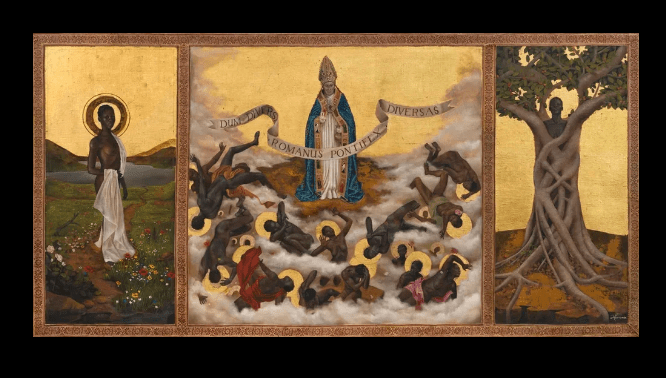
In some of these paintings Rosales narrates the historical suffering of the black natives of this region that were forced into slavery, oppression and abuse by the Catholic church and others declaring Christianity. These images forced me to consider the horror of what people professing Christianity can perpetrate, the pain that can be caused to innocents by pragmatic power-seekers; which is my personal definition of evil.
These images forced me to consider the horror of what people professing Christianity can perpetrate, the pain that can be caused to innocents by pragmatic power-seekers; which is my personal definition of evil.
Looking at this image and others in this exhibition moved me to consider the basics of my own beliefs. To my thinking this provocation is the very purpose of Art. And still, the beauty of the works combined with the truth of the harm done to an unknowing group of people paralyzed me for a time with these questions about my faith: Is my God a bad guy? Did He or does He rejoice in the “forced conversion” of anyone? Does God, the loving Father I know, strong-arm anyone into following Him or worshipping Him? The answer from my over 40 years of Bible study and from personal experience is absolutely NOT!
God does not force Himself on anyone, not even Adam and Eve of old. Over and over the Bible expresses the truth of choices we have to believe in Him or to reject Him. Though God oversaw the pain of these trusting historical people He did not look upon this injustice with folded hands and a blind eye. He hated every moment innocents were used for evil purposes. I know this to be true because I have also suffered deep wounds inflicted by an authority figure, more personal than racial oppression, but none the less debilitating. It is with great assurance I tell you, precious reader, that God was angry at my misuse as a child and He was and continues to be angry about the abuse of His image-bearers today. He is just. He is loving.
The ideas of the struggle of origin and innocence are further expressed by Rosales through her paintings or two figures, Adam and Eve. This artfully portrayed perspective leads me to the second of the three reasons I am repulsed by some of Rosales’ art: truth. In many of the depictions the serpent or satan, is portrayed as only wanting the best for Adam and Eve. God, on the other hand, is illustrated as being absent during His creations’ temptation. Rosales explains in her writings that the discovery of true self comes from knowing good from evil, therefore, our enemy satan/serpent only offers that which is good to humanities’ created “father/mother of origin”; i.e. the ability for them to choose or in her assertion for Adam and Eve to begin self-fulfillment. Flourishing is the result of their feeding in Rosales’ illustrations, rather than death which God tells of in the Bible. Though God warns His children away from disobediently consuming a particular kind of fruit in the garden, Rosales asserts that though the fruit entangles them, their acquiescence to the serpent’s questions actually ends beneficially in their ability to make decisions and be self-fulfilled.
The truth about these events leads to the most important of the three reasons the art of Harmonia Rosales repelled me: power.
Whether this idea of original sin comes from the destructive false teachings of Christianity offered to the Afro-Cuban natives of this culture or it is the way they absorbed Christian ideas into their cultural forms of worshipping the Orishas just to survive, I do not know. For me, this differentiation does not influence how I view Rosales’ art. However, what does influence my acceptance of her figural portrayals as truth is a biblical knowledge of God’s ways, our origin and His intentions for our subsequent relationship with Him. The truth about these events leads to the most important of the three reasons the art of Harmonia Rosales repelled me: power.
Be honest, aren’t you a power seeker? In some way don’t you want your own way because you know you are right? This conflict of self-righteousness is what happened in the garden of Eden. Self-determinism was NOT the salvation of humanity but its very destruction.
Often I enjoy thinking of myself as a goddess; at the very least the art goddess of my classroom.
Here are the verses from the Bible that detail the events in the Garden of Eden: Genesis 2:15 The Lord God took the man and put him in the garden of Eden to work it and keep it. 16And the Lord God commanded the man, saying, “You may surely eat of every tree of the garden, 17but of the tree of the knowledge of good and evil you shall not eat, for in the day that you eat of it you shall surely die.” (English Standard Version)
After the tour of the garden and the warning about was not good came Genesis 3:
1 “Now the serpent was more crafty than any other beast of the field that the Lord God had made. He said to the woman, “Did God actually say, ‘You shall not eat of any tree in the garden’?” 2 And the woman said to the serpent, “We may eat of the fruit of the trees in the garden, 3 but God said, You shall not eat of the fruit of the tree that is in the midst of the garden, neither shall you touch it, lest you die.’”4 But the serpent said to the woman, “You will not surely die. 5 For God knows that when you eat of it your eyes will be opened, and you will be like God, knowing good and evil.” 6 So when the woman saw that the tree was good for food, and that it was a delight to the eyes, and that the tree was to be desired to make one wise, she took of its fruit and ate, and she also gave some to her husband who was with her, and he ate. 7 Then the eyes of both were opened, and they knew that they were naked. And they sewed fig leaves together and made themselves loincloths.” (English Standard Version)
In truth, there is beauty in the paintings of Harmonia Rosales. So much beauty! They also are articulate in showing the power of beauty of the goddesses which replace biblical figures as the subjects of her Renaissance styled representations. Even so, her ideas regarding the Gospel of God are flawed. Power is the goal of the serpent when he approached the innocent Eve. He does not care for Eve. Satan merely wants to discredit God for personal power. Power was absolutely the goal of the Christian conquerers of the Lucumi and who enslaved Afro-Cuban peoples she depicts. These mighty men used their technological advances to enslave and misuse women and children all the name of god. Power is the goal of Eve as she considers satan’s questions, and as a result sides with the serpent in the beauty of the garden. Then her husband, Adam, rather than protecting Eve, exerts his own power by taking his own way as he ate the fruit himself. Many of us may think, “Well played, guys! Now, you have the knowledge to make decisions for yourself because you made an independent choice.” But did they?! Or did they merely listen to another creature to determine what was best for them? Disbelieving the one Person who made them and truly loved them lead to a separation we continue to live through to this day. As a result of their rejection of God, our fleshly father/mother embraced their power: the power of their autonomy, the power of taking their own way because they knew better than God. Adam and Eve embraced the serpent’s lie,“You shall not surely DIE???” And now we do.
I find I usually want to turn first and foremost to what is best for me when I am making decisions. When I saw Rosales’ paintings I was confronted with all the ways I want power or all the ways I enjoy power. Though I was put off by the opulence of the work, I was also leveled by the conviction that I must not embrace self-determinism. I must reject the pleasure I feel with self-righteousness, and I must continue to allow God to speak to me about pain, truth and power. The pain I cause and the pain others inflict upon me must be considered. The truth others believe and spout and the truth that forms reality, must be sifted. The power I see others exerting and demanding and the power I also desire must be confronted.
This art caused me to think about: What is beautiful? Is a goddess truly beautiful? What does Christ’s Gospel, the death of Jesus, His burial and resurrection really have to do with me in the reality of our origins and my daily experience? Does what this art expresses define my beliefs and desires?
Conclusively, I would encourage everyone to see this work. Go to the Spellman in Atlanta to see it! That is where it shows next. The paintings reach much farther than their historical base; they speak to us. Allow this art and all art made in the 21st to speak to your prejudices, your rightness, your self-determinism. Ask yourself, is the artist right? In what ways? Is the artist wrong? Does the artist represent truth? Not merely the truth of the day, which is fleeting and worthless, but the truth of God and life? That is what Art is here for. May the Art move us to live, to consider and to Love God and others.
Discover more from Mind over things that matter
Subscribe to get the latest posts sent to your email.
2 responses to “Beauty, Goddesses and Gospel of Christ’s Origins”
Mary Minor
I wonder if you might have been uncomfortable with not loving the art because the art was coming from the point of view of the oppressed.
Did you feel not loving the work would be justifying the atrocities?
Maybe you felt you would be siding with the unconscionable oppression if you didn’t like the work presented by the oppressed?




 Mind over things that matter
2 responses to “Beauty, Goddesses and Gospel of Christ’s Origins”
I wonder if you might have been uncomfortable with not loving the art because the art was coming from the point of view of the oppressed.
Did you feel not loving the work would be justifying the atrocities?
Maybe you felt you would be siding with the unconscionable oppression if you didn’t like the work presented by the oppressed?
I agree! More on this idea in the responding Post